Sunday, February 27, 2011

G is for Gear Pins


So, I've been working hard at my Multi Engine / IFR Rating.

The Lovely Wife has been working hard at a Medical Terminology course thats a pre-requisite for another course that starts in April.

I've been working my day job, TLW has been a full-time mommy for some time now and we've both been juggling study breaks, personal time and of course, night-shift with The Wee One.

It has gotten to the point where we have an online calendar that we both consult before doing anything, replete with respective study periods, class or lesson times, personal time blocks, family commitments, my work schedule and of course, a small portion of the day where we are expected to sleep...

Hectic, to say the least.

Unfortunately, blogging has taken a back seat to pretty much everything else. The only reason I'm typing this, is I should be practicing hold entries on flight sim and planning a mock IFR cross-country flight and my brain has surrendered. It was either this or play some mindless flash game on facebook.

I just saw The Social Network and have decided I need to stop giving those losers my money and/or contributing to their page-load counts.

In any case, heres an update on the last month or so and some of our happenings, aviation and otherwise.

The Wee One

TWO has had a few milestones lately. They seem to come so fast. Everything she does is usually a first of some sort or other and physiologically speaking, big things are afoot.

She just hit six months and we are easing her into "solids". I use that term loosely, and frankly, so do her bowels. A little Rice Cereal mixed with a bit of mushed-up fruit. A new fruit every three days or so, so we can spot any allergies or other issues. So far, Bananas and Strawberries, all systems nominal.

For the last couple weeks she has made the leap from rolling over onto her tummy and back by herself, to getting up on her hands and knees and rocking back and forth in a threatening manner. The threat of course, is that we will go to the kitchen to prepare her mush and come back to find she has walked into the den and started blogging.

A couple little white pointy daggers have popped out of her gums. Two on the bottom and one up top. Came as a bit of a surprise as there was little fanfare or histrionics with their arrival. A little extra drool and some funny sleep patterns of late, but thats it.

Not that the teeth will assist in any way with her current eating routine of gumming the spoon and rubbing mush into her hair and hands.


Multi-IFR Training

Ack, where to begin. This one is by far the most cerebral part of my flight training so far. An innate set of "Good Hands and Feet" ( which I am not professing to have ) will not save me on this one. Lots to learn and memorize.

I'm currently training on a Seneca II. A Twin-engine, turbocharged, non-pressurized, 7-seat aeroplane.

Quite a nice plane actually and it seems to have power to spare compared with some trainers I had a chance to look at while shopping around. 200 Horsepower a side to be precise, and with the turbochargers, all of that is available, right up to 12,000 feet before she starts gasping for air.

Avionics are very nice as well. Seems the AI and/or DG packed it in a while back on this plane and in the research of the Re and Re, they discovered that installing a partial glass cockpit, in the form of an Aspen HSI system, was cheaper, or at least a relatively inexpensive way to upgrade.

The AI is(was) the Attitude Indicator, the little blue and brown ball shaped instrument that you would use to reference the horizon when it's not visible out the front window. The instrument has a gyroscope inside it, run(usually) by a vacuum system and is a key component in the Instrument-flying instrument set. The DG is the Directional Gyro. Similarly run by vacuum and a gyro, it gives you a compass direction on a stable platform.

That is, more stable than a little piece of paper mounted on a pin and floating in a glass jar full of kerosene and bouncing around in an aeroplane and trying to give you indications of magnetic directions while being packaged inside a metal aircraft and sitting on top of all the radio equipment, electrics and spinning gyro bits....

So anyway, the Aspen system is pretty sweet. It's a "partial glass cockpit" in that a couple of key analog and/or mechanical instruments have been replaced by a small computer display screen that gives you the same info, and more, from a solid-state system.

And wow, does it ever give you more.

In some ways, its frustrating, as I'm trying to learn Instrument flying procedures and regulations, handling a larger aircraft and its extra complement of systems, learning the flight test guide and preparing for the written, but then you throw in a modern GPS system and whole slew of extra little "oh, let me show you this, this is cool, watch what it will do " bits and I find my brain tuning out the nice-to-know stuff in sheer survival mode, for favor of the you-better-damn-well-know-this stuff.

The aircraft has had some mechanical issues of late, but luckily, we are forging ahead with the IFR part of the training, so on a day when I miss out on the Multi-Engine part of the course, due to weather or other issues, we can head over to the Simulator Shack where I can sweat it out for an hour trying to learn and practice some of the stuff I have been dutifully studying for months now.

At Six Bucks a minute in the real airplane( a beer a minute ), I'm more than happy to sit in the sim at a fraction of that and practice it till I've got it semi-down.


Day Job

Work out at the airfield has been busy lately. Mostly busy as we've lost some staff over the last year that haven't been replaced due to the economy. As our company US-Owned, they are feeling the pinch a lot more down there and it is having a trickle down effect onto management up here. As always, the monkey at the top of the tree looks down and sees the smiling faces of all the little worker-monkeys making their way up. The monkey at the bottom looks up and sees nothing but @$$holes.

The fuel distributor that we sell for, has also switched over to a new metering system in our trucks. Our old system was so old it was barely computerized. It had these giant " RAM Cards " that were the size and shape of eight-track cassettes and held the days pumping data on it for download at the end of the day.

I'm sure they held upwards of a kilobyte or two of data on each one. Heady stuff for 1972, not so much today...

Now we have a new system, and it's much maligned, as all new systems are. I could rant all day about it, but I'd probably get in trouble and frankly, you always end up coming across as some progress-reluctant Luddite when ranting about the perceived shortcomings in technological change.

I've done a little work with database systems and crude programming in the past though and even to my untrained eye, I can spot the work of a hack when I see it, that's all I'm going to say.

Job Hunt

Some exciting prospects here...


a company I interviewed with over the phone last year is looking like a good potential prospect for this year. I kept in touch with a couple updated resumes over the winter and I actually just got back from making the trip out to see them and introduce myself and get the tour of their operation. It wasn't technically an "interview", but it was close and I suspect something might materialize on this front. Would mean a move to another province and another adventure. Lots to consider and lots of stuff I shouldn't be talking about until things fall more into place....watch this space...

Aside from that, with the addition of the MIFR rating to my license, it will pretty much be " complete ". That is, there is little more I can add to my license in the way of training and ratings that will help me get a job. Now, all I need to get a job is some experience. But of course to get that, I will need to get a job.....funny how that works...


I saw they are looking for more ultralight instructors down at the grass strip where I worked last summer. I'd love to do it again, but frankly, with The Wee One, I really need to find a full-time flying job...trying to fly part-time, work full time and parent full-time, just doesn't add up. Either that or find a cure for sleeping.

Iphone

TLW and I recently traded in our circa 1986 "contractors model" cell phones for a pair of nifty little Iphones.

Wow.

Now I see what they mean when they say smartphones. These really are little PDA's, with very functional Internet browsing, email, GPS and all kinds of other functionality. Our little calendar I mentioned earlier is based on a google calendar, but is synced up to both our phones. If either of us makes and entry on the calendars on our phones, it automatically updates the main one online and the other phone as well.

Some of the Apps available for this thing are pretty sweet too. Lots of little games and novelty ones, but lots of really useful stuff as well.

Highly recommend.

( but of course, everyone else in the world knew this four years ago, and I'm just now catching up )

Road Trip


As part of my trip out to A Different Province, I got to briefly visit some places from my youth.


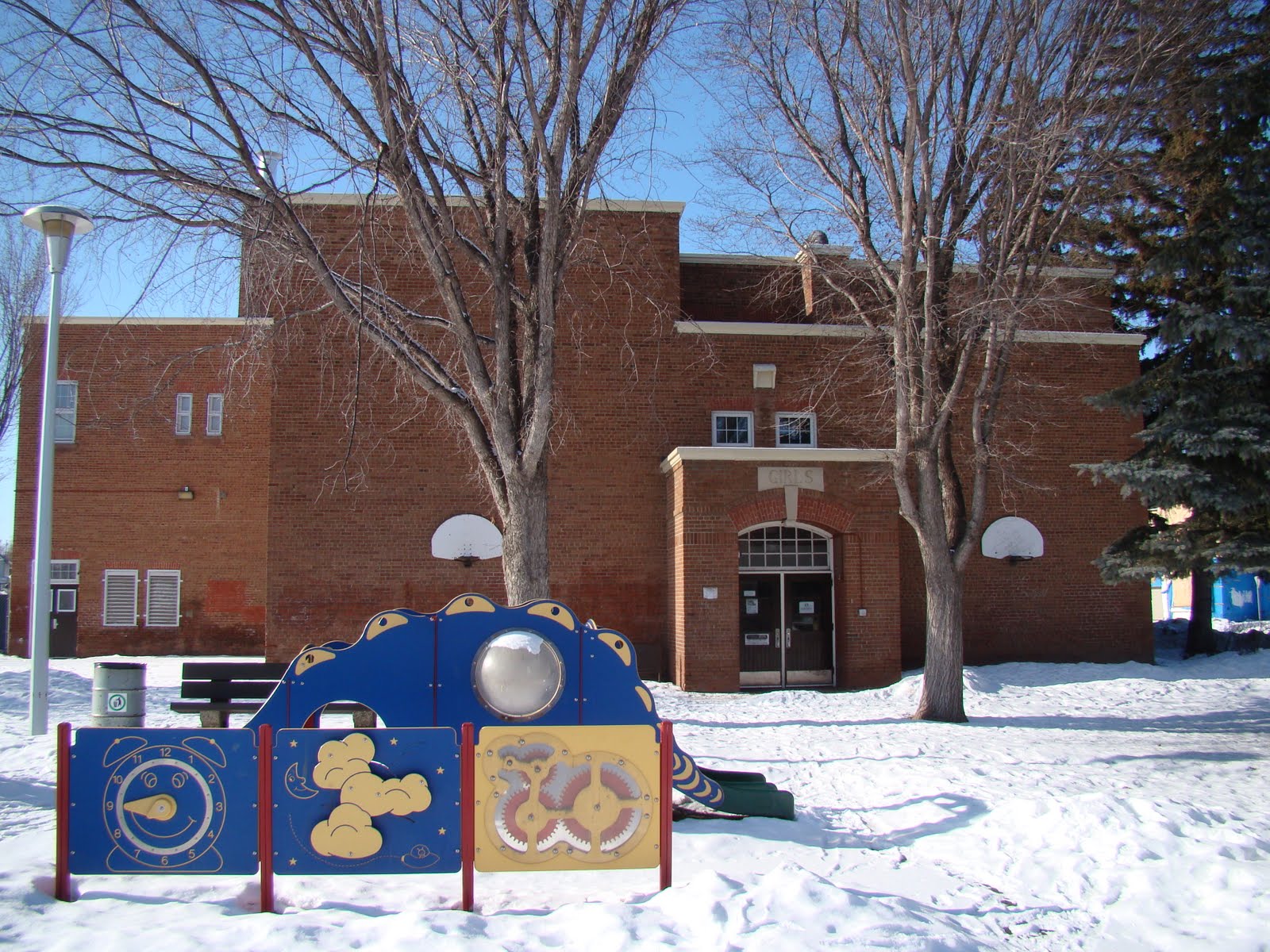
My old elementary school, complete with separate Boys and Girls entrances.


My old house.


The little alleyway off on the right is actually a steep little gravel road that receives No Winter Maintenance from the snow plow. But every year, some yahoo tries to do a hill-climb in their car or truck. Our kitchen window looked out onto this alley and I'd often get to see the offender come level to the window as I did the dishes and slow to a tire-spinning crawl right in front of me... Then I got to watch their cocky grins morph into white knuckle terror as they started, slowly at first but quickly gaining speed, sliding backwards down the hill.

I remember coming home from school one day and finding a giant car-shaped hole in our wall from where one of these losers had slid into it and then slunk away.

Luckily, the house is ( was?) owned and rented out by the city. Ownership being retained by the highways department in consideration of future expansion. At least that was the story twenty years ago when I lived there..


Random Pics;

Some shots of a very interesting visitor to the field recently, a British Military ( RAF ) Vickers VC-10.


This thing has Four engines, mounted two-a-side on the tail. Very unique design and a rare catch indeed for this neck of the woods.


I was poking around a 767 the other day and was looking at the nose gear and thought I'd comment on this.


On most large aircraft, and some smaller corporate jets as well, there is bit of linkage on the nose gear that connects the steering mechanism in the plane, be they cables, hydraulic assist cylinders or otherwise, to the nose wheel assembly. When you are towing some of these aircraft, you need to "disconnect" the steering mechanism otherwise you could damage parts of it when you turn the nose wheel manually with your tug or tow bar.

On some of the larger airliners, because the assemblies are far too heavy to be simply hooked together with a little pin, they have a "bypass" pin that you insert into the appropriate orifice and you have free rein to steer away.


As Linecrew, when towing an aircraft with disconnect-able gear, you had bloody well remember to disconnect before towing and reconnect afterwards. Like all things aviation, it ultimately falls to the pilot to ensure it is in place before he (tries to ) taxi away for take off. But, just because the ultimate liability rests with him, doesn't mean your fair share of vitriol isn't coming down the pipe if you fail to do your job....

Sweet, I've been struggling to come up with something for this posts " G is for..." item and I just stumbled on it!

G is for Gear Pins

A lot of larger aircraft will also have Gear Pins that need to be inserted before the aircraft can be moved around on the ground. The purpose of a Gear Pin is to stop the gear from retracting inadvertently while being towed. Usually its just a little pin say the thickness of a finger, that is inserted into the gear retraction assembly that would physically stop it from retracting.

As Linecrew, part of the service you can offer is to put the pins in place while the pilots are dealing with passengers or putting the aircraft to bed. Particularly where the main gear require a little bit of a stoop or kneel on the dirty ramp to put the pin in place. White pilot shirts and slacks generally do not stand up to this too well. As a good linecrew, you know where the pins are stored on the aircraft ( little cubbyhole on the stairs or in a cabinet inside ) and have them in even before the crew notices. Again, still their responsibility to ensure they're actually in...


I thought this was kind of neat too. On the nose gear, there is a panel for the ground crew to operate some functions on the aircraft, from outside. One of those functions is to shut off the APU ( Auxiliary Power Unit ), and on this one, you can actually discharge the fire extinguisher bottle into the APU if it catches fire. I've seen this on some Airbus aircraft as well, actually on the fuelers panel. Which is kind of handy as in a lot of cases when you are fueling an aircraft, the crew is upstairs with the APU running and you're the only one down stairs. If a fuel-related emergency were to occur, you might not be free to run upstairs and tell them to shut off the APU ( or to evacuate, for that matter ). Shutting it down on them though would certainly get their attention.

Saturday, January 8, 2011

F is for Filming


Occasionally the FBO where I work is used as a movie set. This week it was some US television series I had never heard of, but based on the amount of equipment they brought, it is obviously a big deal.

My favourite piece of kit they bring is the catering truck.

The Lovely Wife introduced me years ago to the Catering Caper and I've enjoyed it ever since. The fact is most movie shoots are comprised of many different contractors, all brought together to do their little part of the big picture. One of these contractors is the Caterer. The Caterer is simply tasked with feeding everyone on set, ie all the different contractors, actors, etc. The beauty is, they have no idea who is who and if you are packing a walkie-talkie, a clipboard and/or a reflective vest and make your way to the food area, chances are, you're getting fed.

The food was good.

( PS - I think I blogged about this before, but can't remember and am too lazy to look. Sometimes I find I have done this and can't help but think I am gravitating towards being THAT guy.. the one who has run out of interesting stories and starts repeating himself.... )


F is for Fire

Not something you'll find airside..hopefully... but definitely something we have to prepare for and take measures against. We used to wear Fire Retardant uniforms but sometime last year they decided that wasn't necessary anymore. Not sure what the justification was or if it as a simple cost/risk analysis, but there it is. We take Fire Extinguisher training every year and have no less than three extinguishers on each truck, one in the cab and two big ones on the back of the truck as well. We've also got a big 200 Pounder on wheels in front of the building in case of an aircraft fire. It kind of looks funny as it has great big wagon-wheel style wheels on it..

Most of the staff is of a similar mindset when it comes to this bad boy. That is, if there is ever a fire big enough that it is needed, chances are, we will have long since run away anyhow. I suppose if there were people trapped in a plane or something, it would change things somewhat.

A few years ago, the Avgas truck at one of our competitors had a mechanical malfunction while it was idling on their ramp and ended up catching fire. The fire started in the cab and they tried to fight it with hand-held extinguishers while it was small enough, but eventually, they ran away as well.

I'm told it took over 30 minutes for the local ARFF trrucks to show up, which, frankly, I have a hard time believing. But I'm curious if they would have run away as well. I wouldn't go anywhere near a burning Avgas truck. No way, No how. Turns out, the truck burned to the ground, with the tank and its flammable contents intact.

Luckily, 99% of our fuel sales are Jet Fuel. Jet fuel is very similar to Diesel and is very difficult to ignite. Similar to gasoline, the fluid form of jet fuel is actually not "flammable". You can throw lit matches into a puddle of jet fuel all day and not worry about it. Both gasoline and jet fuel need to be in vapour form in order to be lit by an open flame. In a liquid form, there simply isn't a combustible mixture, lots of fuel, a source of heat, but not enough oxygen to make it work. The mixture is simply too "rich". Add some heat, say from hot tarmac or a hot engine part and the fuel will start evaporating, turning into a vapour and mixing with the air.

Now we're getting somewhere.

Now we have a mixture that WILL ignite with an open flame. Gasoline will evaporate and create flammable vapours at practically room temperature. Jet fuel, needs to be much, much hotter to create a mixture that will burn. The temperature at which a fuel will create flammable evaporative vapours is known as its flashpoint. A puddle of gasoline on a hot ramp, will have a layer of highly flammable vapours coming off it, that you can even see on a hot day. Jet fuel won't.

Further to Jet fuel being relatively stable, a very large percentage of our deliveries into-plane are done in a closed system. The single-point nozzles are designed to deliver fuel without exposing it to the air ( or the fueler ) and any opportunity for unintentional evaporation.


F is for Frustration

Started working on my Multi-IFR over two months ago and at this rate, 2013 is looking pretty good for completion. Unless it happens to rain next winter...at all. I can only dedicate my two weekend days to flying and my instructor has my other day off, monday, as his fixed day off as well. The plane was down for mechanical repairs for almost three weeks in December and my instructor has also taken a three week vacation over the holidays. I'm starting to think that the goal of getting the entire MIFR done on a part-time basis between now and April might not be realistic. I'm already starting to consider only finishing the multi portion and maybe looking for another seasonal job for the summer.

Between TLW's mat leave and renting out our place for the summer, we could probably swing a summer away if I could find something worth going for. Accommodations are probably going to be the single largest deciding factor though. I'd also have to get approval for another leave of absence from my current employer as we'd be back in the fall.

It would be a lot nicer to finish the MIFR and actually be able to move somewhere semi-permanently, even if it meant working on the ground for a little while longer.

So yeah, frustrating.


F is for Freighter, Foreign


This occurred a few months ago, but I don't think I ever got around to posting the pics or details. One of our local Helicopter outfits was shipping a couple of Super Puma helicopters over to Afghanistan, and they chartered an Antonov 124 freighter to come in and pick them up.


The helicopters were staged on our ramp for a couple days while they worked on getting them ready for shipping. Mostly this involved taking the blades off and crating them up, not sure what else they did as both birds looked pretty ready-to-go once they got their blades back.

We were tasked with baby-sitting the workers as they came and went from the disassembly area as most of them did not have airside access passes and needed to be escorted to and fro with Block Passes. The local airport authority sent out three little security cars as well to set up a little perimeter around the work are and make sure no one wandered off down the taxiway.

The security guys come out for the movie shoots as well, and essentially they take a chunk of airside ramp and turn it into a non-restricted area so that all the (well fed ) workers can come and go without too much trouble.

I also got called in for an extra shift on the weekend that the AN-124 came in to help tow the helicopters over to the other side of the field where the freighter would be parking and be there to help the crew if they needed our services.


Our ramp isn't quite big enough to handle an AN124, so we used the Air Canada ramp instead.

Day of, and the freight forwarder ( Panalpina ) sent out their Heli-Logistics guy to come and oversee the whole deal. I've done a few project jobs like this and it is usually fun. If everything is well organized and planned out in advance, the forwarder is just a third wheel, but the minute something goes wrong, guess who everyone turns to, looking for Plan B?

Me and the other guy who were going to do the tow decided we'd have one guy on the tug and another taking up lead in one of the vans. The vans have much better radios ( and you don't have to compete with the tugs engine to hear them ) and we had quite a few people who wanted to ride-along.

The other guy has done a lot more towing than me, and doesn't like talking to Ground Control, so he took the tug and I took lead in the Van. Most of the towing I do is with the Lektro, a special vehicle designed for towing aircraft by lifting the nosewheel off the ground. Frankly, its kind of cheating it's so easy. You can still get in trouble if you don't know what you're doing, but the fact that you steer through the aircrafts nosewheel instead of through a pintle hook and two points of attachment a la a tow bar, makes it laughably easier than towing with a tow bar. As these helicopters have a very low front end, we can't "scoop" them with the Lektro, so its tow-bar time..luckily not for me.

My usual towing jobs involve vey short distances on the field, mostly one or two taxiways at most and rarely across any active runways. This time I made sure I had a pen and paper ready for my taxi clearance from ground.

Helicopter Tow plus one, cleared Alpha, Foxtrot, Charlie, Hold short runway 26 left.

Cross runay 26 Left, Delta-five, Delta to the ramp.

We got the helicopters in place and waited for the Antonov, wasn't hard to miss it on approach, the black smear of exhaust behind it was pretty obvious.


As it taxied in, we all noticed that the ground handling company that had been arranged was not there... They were supposed to be there with marshallers and a ground power unit. Just as I took the spare wands out of the van and prepared to marshal him in myself, one guy in a pickup showed up. The arrival schedule had changed at least three times over the past week and I guess no one had notified them. I was kind of disappointed as it would have been my first time marshalling one of these, but glad at the same time as it was pretty tight.


Friday, December 24, 2010

Not mine, but seasonally appropriate.

Merry Christmas everyone!


Twas the night before Christmas, and out on the ramp,
Not an airplane was stirring, not even a Champ.

The aircraft were fastened to tiedowns with care,
In hopes that come morning, they all would be there.

The fuel trucks were nestled, all snug in their spots,
With gusts from two-forty at 39 knots.

I slumped at the fuel desk, now finally caught up,
And settled down comfortably, resting my butt.

When the radio lit up with noise and with chatter,
I turned up the scanner to see what was the matter.

A voice clearly heard over static and snow,
Called for clearance to land at the airport below.

He barked his transmission so lively and quick,
I'd have sworn that the call sign he used was "St. Nick".

I ran to the panel to turn up the lights,
The better to welcome this magical flight.

He called his position, no room for denial,
"St. Nicholas One, turnin' left onto final."

And what to my wondering eyes should appear,
But a Rutan-built sleigh, with eight Rotax Reindeer!

With vectors to final, down the glideslope he came,
As he passed all fixes, he called them by name:

"Now Ringo! Now Tolga! Now Trini and Bacun!
On Comet! On Cupid!" What pills was he takin'?

While controllers were sittin', and scratchin' their head,
They phoned to my office, and I heard it with dread,
The message they left was both urgent and dour:

"When Santa pulls in, have him please call the tower."

He landed like silk, with the sled runners sparking,
Then I heard "Left at Charlie," and "Taxi to parking."

He slowed to a taxi, turned off of three-oh
And stopped on the ramp with a "Ho, ho-ho-ho..."

He stepped out of the sleigh, but before he could talk,
I ran out to meet him with my best set of chocks.

His red helmet and goggles were covered with frost
And his beard was all blackened from Reindeer exhaust.

His breath smelled like peppermint, gone slightly stale,
And he puffed on a pipe, but he didn't inhale.

His cheeks were all rosy and jiggled like jelly,
His boots were as black as a cropduster's belly.

He was chubby and plump, in his suit of bright red,
And he asked me to "fill it, with hundred low-lead."

He came dashing in from the snow-covered pump,
I knew he was anxious for drainin' the sump.

I spoke not a word, but went straight to my work,
And I filled up the sleigh, but I spilled like a jerk.

He came out of the restroom, and sighed in relief,
Then he picked up a phone for a Flight Service brief.

And I thought as he silently scribed in his log,
These reindeer could land in an eighth-mile fog.

He completed his pre-flight, from the front to the rear,
Then he put on his headset, and I heard him yell, "Clear!"

And laying a finger on his push-to-talk,
He called up the tower for clearance and squawk.

"Take taxiway Charlie, the southbound direction,
Turn right three-two-zero at pilot's discretion"

He sped down the runway, the best of the best,
"Your traffic's a Grumman, inbound from the west."

Then I heard him proclaim, as he climbed through the night,

"Merry Christmas to all! I have traffic in sight."

Tuesday, December 14, 2010

E is for Emergency


E is for Emergency(ies)

And we do get the odd one from time to time out here. Most of the time they are a non-event. A cockpit indication that may or may not mean something is or isn't going to do what you want it to do when you need it to do what it is supposed to do when you ask it to do it.

We have a prettty clear view over to the fire hall on the other side of the field, so when they roll the crash trucks, all the flashing lights usually catches someones eye. The call on the radio on our end is usually that " someones getting a parade ". I like to grab one of the handheld Icom radios and tune into Tower frequency and listen in. The ARFF ( Aircraft Rescue Fire Fighting ) trucks will usually position themselves at the arrival, mid-point and departure end of the runway where the parade-recipient is landing and once they are down they will go onto the runway and follow the aircraft.

If it's a real emergency, the aircraft usually stops on the runway. If its an emergency of the faulty-instrument-bulb variety, then they will follow the plane to the gate and then go back to the firehall.

When it's the real deal, the fire trucks will relay to tower a discrete frequency for the aircraft to speak with them directly on, so they can coordinate shutting down engines, putting out brake fires, evacuating or de-planing passengers and what not.


In this particular case, it was a rejected take-off caused by birds being ingested into one of the engines causing the engine to fail quite spectacularly. There was a loud series of bangs and a couple big puffs of smoke. Then they sent out FodZilla, our airport's resident street sweeper truck, to clean up the mess on the runway. If you look closely, you can see the big FodZilla sticker on the side of the truck.

FYI - FOD is an abbreviation for either Foreign Object Debris or Foreign Object Damage, depending on whether you found the offending Foreign Object before or after it hit or was ingested by an aircraft.


E is for Eating

A favorite pastime of mine...and something I routinely get to do in the airport environment. We tend to get a fair bit of left-over catering off arriving aircraft. Especially the larger aircraft that transport sports teams. If there are 40 people on board, there are 40 Chicken and 40 Fish meals, along with snacks, drinks, desserts. If you are chartering a transport category aircraft for only 40 people, the catering bill is the least of your concern. The crew already tucked one away in their luggage for the hotel room and since you helped them get their gear out of the cargo area, tidy up the cabin and run them to the hotel, you'll usually get a stack of the meals, a tray or two of cheese, meats, desserts and whatever else they have for your troubles.

One of my neighbours just completed his flight-attendant training and they happened to do the on-aircraft portion of their class at our FBO. I ran into him a few times and took the opportunity to " train " him myself on the important aspects of line-crew / flightcrew relations and upkeep thereof. Give the food the the lineguys before the catering trucks show up and pitch it all in the garbage and you'll never carry your bags down the air-stairs yourself again.


E is for Engine Start

When we're marshalling out an aircraft, one of the more important things we're doing is helping to make sure engine start is done safely. The part most people see is all the arm-waving when the planes are moving to or fro their parking spot, but for the most part, the pilots know where they are going. The marshaller is really just there to watch out behind the plane, where the pilot can't see and assist in tight quarters to make sure they don't run into anything. I've talked to some guys who are quite convinced they are running the show when they get a hold of a couple lighted wands, but I know better. We are an added layer of safety, like chocks on an air-brake equipped truck.

Once the passengers and crew are aboard, the marshaller takes up position in front of the nose of the aircraft, in eye contact with the captain, who sits(usually) in the left seat. When they work their way through the checklist to the part where they want to light up an engine ,they will hold up one finger or two, depending on which engine they want to start. The marshaller will signal in return by pointing to the concerned engine with the wand and waving the other wand vertically, over his head in a circular motion.

Engines are numbered 1 through whatever, usually just 2, but in theory, as many as 8, starting from the captains left, or the aircrafts left wing.


The marshallers main job during engine start is to make sure there is no one passing behind the aircraft and that the general area is clear. if it isn't safe to do so, the marshaller will hold the wands up, crossed in an X, indicating to hold off on starting. Unfortunately, this whole dance is so routine, that it can be hard to get the pilot to stop. They are expecting you to indicate all-clear, you have the last 100 times. More than once I've requested a stop, had eye contact with the pilot while indicating not-clear, and have them carry on and start up anyways.

The other function during engine start is fire-watch. A lot of fuel is moved around during start and not all of it gets burned. Some aircraft actually leave a little puddle of unburned fuel on startup or shutdown. The marshaller needs to be ready to signal the pilot in case there is any type of fire. Its one marshalling signal that a lot of marshallers don't actually know as they probably learned it once and then never used it again.... I suspect if you used the proper signal they wouldn't know what the hell you were trying to say. The look on your face though would probably give it away. I think I would resort to basic (frantic) hand gestures if I got any sort of confused look from a pilot if I ever had to use that particular marshalling signal.


Someone just mentioned to me the other day that the mechanics that were on trial for the crash of the concorde in Paris were found guilty of manslaughter recently.

Basically, an American Airlines aircraft that departed before Concorde, left a part of some kind of the runway. That part, once run over by Concorde, proceeded to be deflected upwards at highspeed, puncturing the wing and fuel tank just before take off. Leading to a large in-flight fire, crash and the death of all aboard and the end of the Concorde altogether.

I would like to think of France as being a civilized country and I sincerely hope that if there was negligence on the part of the mechanics, that it was gross negligence in order to find them guilty. I'd hate to think there was simply pressure to scapegoat someone. Particularly given the clientele that usually rode around on Concorde. The cynic in me wonders of those particular passengers and surviving families might have a bit more sway than usual... I'm all for being accountable, especially when your job demands it by its nature, but it seems easy to take it too far sometimes.

Sunday, December 12, 2010

D is for Diesel


This is a little out of order, as this happened a few months ago, but I just found the pictures, so bear with me.

Over the summer, I went for a fun little flight with a friend of mine from work, Bruce. Bruce recently went to one of the local flight schools to renew his Private Pilots License and in the process, got himself checked out in the schools shiny new Diesel Powered 172.


Most 172's run on AvGas ( 100 Octane, Low Lead - 100LL or AvGas ), but this one has a diesel engine in it and it actually runs on Jet-A, Jet fuel. Jet Fuel and diesel and very similar, in fact I think the only difference is diesel has some added lubricants in the fuel, where Jet-A is quite a bit "drier". You can run Jet fuel in a diesel powered vehicle ( don't get me started, but you can run almost anything in a diesel!! ) but its not recommended for repeated or prolonged use. I suspect diesel fuel will run just fine in a jet engine as well, except for the small problem of it voiding manufacturers warranties and requiring six-figure engine rebuilds to satisfy re-certification....details...


It is also a very new airplane, and has what is known as a FADEC system. I'm a little fuzzy on the details, but I think its Full Authority Digital Engine Control. Essentially, its fuel injected and a computer runs not only the engine and fuel mixtures, but also the propeller RPM to coordinate different power settings as well. I think it does a few other wizard-y things as well.


One of the neat little tricks it does is a push-button run-up. Get yourself set up in the run-up bay and hold down the run-up button and it goes through all the checks on the engine and gauges for you, giving you a green light when its done. cool.

Except that it does the run-up at full power....yikes.

It has a constant speed prop, but with the FADEC system, you'd never know it. You simply set percentage of power required on the throttle and the wizards match engine and prop power output for you.

We took off out of Boundary Bay and flew up the coast to Powell River, an airport Bruce hadn't been to before, but I had been into a couple of times.


A fun trip and a chance to fly with someone I hadn't flown with before. ( I reciprocated a few weeks later and posted the details of a trip to Qualicum in one of the ultralights, in case he looks familiar ).


We didn't do much at Powell River, mostly hung around the airport watching this guy do long-line practice with a helicopter.


It was kind of funny actually, he called up on the radio after we announced our arrival intentions about 10 minutes out, but neither of us caught that he was a helicopter. Once we got into the circuit, he checked in again and said he'd be " over the threshold of XX runway ", which confused us..till we spotted him and it all became clear.


On the way back, we came across a new Diamond TwinStar in flight and they asked us over the radio if we had a camera on board. I replied that we did, and we proceeded to take a few nice air-to-air shots of it for them.


This is the same Twinstar I later took a look at for doing my MIFR in. Shiny.


A local Hostel and Machine shop in Gibsons also had burned down the previous day, got a picture as we flew over, but it didn't really turn out.


D is also for DI's

A DI is a Daily Inspection. Done on all our Fuel Trucks by the Day Shift folks. I used to work Day Shift and used to do the DI's as well. When you get your commercial drivers license, one of the big things that you have to do and show an examiner that you can do, is a pre-trip inspection. A DI is essentially just a pre-trip, but since our trucks are in continuous use all day, we basically just do one big "pre-trip" at the beginning of the day. I remember in the driving test they give you a set amount of time, twenty minutes I think, and they warn you five minutes before time runs out. Not that all the requisite items aren't being checked, but the Test pre-trip and a real-life pre-trip are two very different animals. On the test, you're under the truck with the coveralls on and inspecting frame rails for cracking. In real life, its a flashlight on bended knee.


D is for D

My Airport pass is a "D" pass, it allows me into the airside restricted area, and it also allows me to operate a vehicle on an active taxiway, runway or apron. It requires a security check, a radio operators license and a driving test with the airport authority. Another type of pass is a D/A, which allows vehicle operation airside, but only on the ramps and vehicle corridors and service roads, no driving anywhere that requires a clearance.


D is for Ducks

We've got a lot of them at our airport. A major river delta along a migratory path, go figure. The airport authority has a few guys in trucks whose job it is to drive around all day and scare of the ducks, geese, hawks, eagles and other wildlife. They've got all sorts of noisemakers, sirens, firecrackers and lights to keep the birds away from the runways. I had one pop by the FBO one night when I was working graveyards and he showed me all the gear they give him.

There was a pistol in the console of the truck and a shotgun in a rack as well. I thought they used them to fire off the firecrackers, but they were the real deal and he said they do use them. Particularly if the bird is nesting airside, they tend to get the short straw as there is little reasonable way to keep them from coming back I guess.


D is also for Dirty Diapers.

Not many of them on the ramp, but I've got a few!!!

Sunday, October 24, 2010

C is for Circadian Rhythms


Ok, before I get into the flimsily disguised motivational trick I'm trying to use to actually post an entry, a quick update on happenings.

This is for the odd person who reads to keep up with happenings in our little family as opposed to the incredibly boring and trivial aviation stuff I try to stick to with this blog.

So, we had a baby girl about two months ago and she's doing great! The sleep schedules and feeding-changing-burping-wailing cycles are getting rhythmic and less and less daunting by the day. Your daily schedule starts to be more and more predictable, but still a handful to say the least.

The last month or so we've developed a pretty good night time schedule that gaurantees both of us a solid 6 hours of uninterrupted sleep. Unfortunately, as of late, Our Little Girl ( OLG ) has developed a penchant for sleeping ON us instead of near us, or in a crib / basket / desk drawer / cardboard box like she used to be satisfied with.


On the one hand, there is nothing better than looking down at her little face snuggled into your chest sleeping peacefully. On the other hand, there is nothing more frustrating than having a big chunk of "free" time, while she is sleeping and being completely immobilized and unable to accomplish anything more usefull and productive than gazing at her.

We've had lots of suggestions from friends and family and have been reading some great books about different methods of sleep training, but its a slow process of trial and error.

She's eating about 70/30 Formula to Pumped Breast Milk, and we sometimes wonder how the heck breast-feeding moms can keep up with the demand! Bottle washing / sterilizing and mixing formula is a new little routine around here.

Diapers aren't nearly as bad as I thought they would be pre-OLG. I had heard stories of hundreds of dollars a month to keep up, but its not nearly so bad.

Still waiting for her to smile on a regular basis. We've had a few, but it's hard to realistically not blame them on gas.... most of them have been random just-waking-up or falling asleep moments as opposed to our efforts to make her smile.

Her little SIN card showed up the other day too, a few days after her birth certificate. It's official now, her sovereignty has been recognized by the state.

I did some shopping around at the local flight schools to find one to do my multi engine rating and IFR rating at this winter. Commonly done together, this rating is usually referred to as a MIFR or multi-eye-eff-arr. This would allow me to fly an aircraft with more than one engine and also to fly one on instruments alone. Done together, as the IFR part has to be done for the type of aircraft you want to fly under instrument rules. You can do a Single-Engine IFR ( called a Group 3 ), but its not nearly as useful as the multi-engine variety ( Group 1 ). Most outfits that fly their aircraft under IFR rules, use multi engine aircraft.

A few non-aviation folks I've talked to about this have asked such things as " so, then you can fly a 747? " or " are you hoping to get on with Air Canada, I hear they are hiring ? ".

Short answer is no.

My bare commercial license with a MIFR rating attached to it, hopefully by spring, will simply allow me to expand my job search a little bit. A few more bullets in the gun so to speak.

One outfit that I spoke to, and asked me to stay in touch with them, flies both single and multi-engine aircraft. The single engine aircraft are flown under VFR, the multi ones are IFR machines. While I would technically be qualified to fly the singles, and that would be the entry-level position I would hope for, my value to them is drastically reduced as that would be the limit of my usefullness. The IFR rating, while not immediately usefull in that scenario, would give me a little more value as a longer(ish) term employee to them.

To simplify as well, for those who tuned in for the first non-aviation bit and are still hanging around, VFR and IFR are the different sets of "rules" that airplanes fly under.

VFR is Visual Flight Rules. No going into clouds, keeping the ground in sight at all times, occasionally talking to Air Traffic Control and always using the see-and-avoid principle of other-airplane-and-large-immovable-object avoidance. The primary instrument that the pilot uses while flying under VFR is the windshield coupled to a calibrated set of mk I eyeballs.

IFR is Instrument Flight Rules. Going into clouds is OK and the windshield as a navigational and operating instrument is only used during certain phases of flight. Most notably landing and taking off. While you've heard of airliners that " land themselves ", this is not very common. More often than not, once the gadgets, gizmo's and little wizards have guided you electronically through the sky to your destination, once it's there( the landing runway ), filling the windshield, you would visually land your plane just as a VFR airplane would.

For those of you that know better, please play along, I'm trying to simplify this and leave out all the subject to, unless otherwise authorized by the minister, except in cases of subsection 4(b)1-3 type of stuff.

In any case, the MIFR is back on the radar for a couple of reasons. First of all, my original " plan " of flying floats for a few years to " build time " in order to get considered for year-round work, is, upon closer inspection not a very good option for us. Most of the guys I met who are doing that, get 2-300 hours a year, if they are lucky. For that they need to uproot every summer and live apart from loved ones. For every one of those hours they get, they also spent 2-3 hours fixing outboard motors, building docks, repairing cabins, guiding fisherman, cutting up ungulates and doing whatever else was required. The flying I like, the ungulate-cutting I can take or leave.

So, I did my due diligence and made the rounds of the more reputable outfits in town that provided this type of training.

School#1

One outfit I went to had a nice little twin-engine trainer, a little rough around the edges, like most training aircraft, and a helpful staff and instructor. They took the time to walk me through their course, show me the plane and in general, try and sell me on choosing their operation. Its hard not to be cynical during this process as this is their business and you are a customer. Similar to the car salesman telling you how fantastic you look behind the wheel of whatever model they are trying to sell you, you get lots of " oh, you knew that? Well, you should be able to breeze through this course! ". This outfit also had a recent change of ownership and kudos to them ,very customer service focused and professional. Unfortunately, they share a Simulator with another, very busy, school and only have one instructor who does the MIFR training. The single instructor bit isn't too big a deal, but I worried about sim access. Since so much of the IFR course can be done in the sim, I didn't want to be stuck fighting for slots while being at the bottom of the pecking order behind another schools own students.


School #2

Another one, had a very modern multi-engine trainer. So modern in fact, that it made my spidey senses tingle... While everyone else in the area is using 20 ( and up ) year old aircraft to do flight training in, these guys are using brand new aircraft. Their rates are competitive with everyone else as well, so its hard not to be cynical about their business model. I did however go in and talk to them and while the CFI was very nice, and a bit of an internet / forum / blogosphere celebrity, I decided to take a pass. Most of their students seem to be overseas and foreign students, in itself not an issue at all, but I just felt a little out of place. The CFI wasn't in when I popped over and the young instructor who I spoke to didnt seem too interested in selling me on their offerings. The extent of his pitch was that I " could go sit in the plane...if I wanted to. " I did, of course, and enjoyed a nice chat with the CFI a bit later, but in the end decided that while shiny, fancy and modern, I probably would be better served training on the type of aircraft I am more likely to be considered to fly in....20 years and older.....


Some days it seems like by the time I get to plunk myself down in a "modern" airplane, they won't be very modern anymore...

School#3

#3 was where I did my original flight training on, both my private license and my commercial license.


I enjoyed my PPL course there, but again, felt out of place during the latter half of my time there. Too many barely-20-somethings with giant mirrored sunglasses and frankly, a lot of people on staff who had no idea who I was after flying there 2 or 3 times a week for two years. A good outfit, and a great reputation locally, but a few too many times standing in front of the counter waiting for the young instructors to finish their personal conversations while my booking slot on the aircraft dwindled away....

School#4

#4 was a place I had heard a few good reviews about on AvCanada, in particular about their CFI. I went over there expecting to spend 20 minutes to a half hour getting the schpiel, brochure and sit-in-the-airplane tour, but ended up with an hour and a half with the main MIFR instructor and a free half hour playing around in the sim.

I have to admit, my attitudes towards flight training have changed quite a bit since the first dollar I plunked down. In the beginning, I was pretty much in awe of everything they had to say and, frankly, a bit naive about the whole thing. Now, I definitely feel its more of a business transaction. I need X service, have determined the market is charging X dollars and I want a competitive rate, but will pay more for the parts of the service I have decided are worth more to me in particular. Well maintained aircraft that are available when I need them, instructors who are good at their jobs and willing to work around my schedule to some degree and a general sense of continued appreciation for my business.

Their facility was fantastic. Clean and professional looking, nicely organized and well kept. The airplanes were plentiful, well equipped and well maintained. Fresh paint and new interiors are nice, but a seat-back pocket with no 3 month old sick-sacks, 43 pens rolling around on the floor and a complete absence of oil-soaked paper towels tells me more about how the employees and owner treat the equipment and their customers.

The owner took the time to get to know me a little and I was sold when I watched him running around greeting everyone who walked in the door while simultaneously cleaning the office and making fresh coffee. You could tell he truly has his heart in his business. It's always possible that he's a raging tyrant away from the customers eyes and that explains the meticulous appearance of the operation, but his staff seemed a little too happy to be there as well.

Its kind of funny though, they share a very similar name with another flight training outfit at the same airport, but this other outfit is bizarre. I'm not even making this up, but on their website, under the corporate officers of the company, they list one female member of the board with a corporate title of " model / actress ". I swear there is even a picture of her draped over a sports car wearing a fur coat. yeah.

So, I picked up my books and spent the next two weeks doing all the pre-reading for the course.

The Multi rating is first, so a couple of texts on multi engine handling and theory, the course syllabus itself, as well as the airplane's flight manual ( AFM ) or Pilots Operating Handbook( POH ).

On reading through the multi-engine texts, I got a little chuckle. The aforementioned " modern " aircraft offered to me at the other school was mentioned a few times. In at least three separate cases the book would go into detail on semi-complicated procedures such as constant-speed prop control, prop feathering or engine mixture leaning and then at the end of the chapter they'd mention, " except for the ACME Super-Duper Model A, where you only need to press a button. ". I almost wonder if its too fancy for its own good, particularly as a training aircraft.

More posts to come on the multi-course, I've done some simulator sessions as well as a flight in the aircraft itself as of this writing, but I'm hoping to put together its own post on that later.

Oh, Right. Ramp workers Alphabet.


C is for Circadian Rythmn

Like with a newborn, better get used to modification. Large airports are generally 24/7/365 operations. Someone has to work the graveyard shift....guess who, junior boy?


C is for Chocks, Cones and Carpets.

At the FBO, every arriving aircraft has at least two of its landing gear wheels " chocked ", so that the pilot can release his parking brake ( or not set them in the first place ) allowing us to tow the airplane off to its hangar spot or ramp parking space later. We can still tow it with the brakes on, but the black rubber marks makes our ramp look bad.

Wingtips, nose and tail also get a safety cone. A lot of the time you have limo's, golf carts, fuel trucks, tugs and other vehicles operating in close proximity to the aircraft. The cones are pretty cheap insurance against multi million dollar fender benders.

I like to make sure the left wingtip gets its cone first. The baggage compartment on most business jets is on the left rear and the passenger door on the left front. First out the passenger door is usually the FO, who bee-lines for the baggage compartment to get the bags coming out before the passengers even step off the aircraft. More often than not, the passengers will follow and collect their bags as they come out. They could just go inside and we will bring them in, or even take them straight to their cab / limo, but the new-money folks always try to walk around to the back to get their bags. Indubitably, they cut the corner at the wing as they come around and I've seen more than one snag a static wick on their way. Small pointy, stick looking things that project off the wingtips and trailing edges of the wing and horizontal stabilizers to dissipate static while airborne. Can make a nasty cut or puncture if walked into and can be expensive to replace.


These are typical of the chocks we use. These particular chocks are tied to a truck and there is a little story behind that. A few months ago, HQ came out with a new directive that all fueling trucks must be chocked when the driver is out of the cab, particularly when fueling an aircraft. Now... all of the trucks we use have Air-Brakes. Air Brakes were designed specifically for large trucks as a fail-safe system to prevent them from rolling away. The way they work is that a metal spring actually activates the brake piston, instead of hydraulic pressure supplied by a pump, supplied by power from a running engine. This way, even if the engine is not running, the brakes will have " power " from the metal spring. In fact, you need the high-pressure air supplied by a running engine ( via a compressor ) to actually release the brakes and keep them released. If the engine dies, or any part of the air line is ruptured, brakes come on...and stay on.

So, to put chocks under the tires, is a little over the top, some might say. There is a slight chance that you would forget to set the brake in the first place, and get out of the truck with the engine running and the chocks would in fact save the day.

In any case... much debate from everyone about this extra precaution... Some pointed out that if there was an emergency ( fire ), you might want to drive away without the delay of pulling the chocks. It only took a couple days before a few of us did that unintentionally and found you can drive right over them without even noticing. The only way you can tell you did it, was that everyone within view of you is giggling and pointing at you.

Then the other argument came up that if there was an emergency and you drove away , leaving the chocks behind, that they would be a tripping hazard for the responders. I personally thought this was the silliest thing I'd heard yet. I think if a fire-fighter is prepared to come running up to a giant, thin-gauge aluminum structure, filled with jet fuel and people, they aren't going to be scared of my little chocks getting in their way.

Thats why these chocks are tied to the truck. You drive away from these bad boys and not only do the people in the immediate vicinity get to laugh at you, but so does everyone you come across allll the way back to base, watching them bounce along behind you.

I also mentioned in the discussions was my personal philosophy on the issue. So long as the companies cheques keep clearing my bank account, they can ask me to do all manner of silly things. In fact, since I get compensated per hour of my time, they are more than welcome to give me more and more tasks, silly or otherwise. In light of the above compensation-by-the-hour, I also have to admit a soft spot for a company willing to pay ME money to do tasks which cost IT real money, but add a layer of safety for ME.


C is for Cold.

Both the Viral and Climatic types. I'm currently enjoying neither.

We've had a couple " snow events " as we call them out here on the Wet Coast. The rest of Canada of course, calls these types of events "winter", but its not normal for us. ( Read: haha - suckers. )

I'm still stubbornly refusing to get winter tires on my car. I don't even have all-seasons, just summer tires. Since I learned to drive in the frozen wastelands of Edmonton, I figure my summer-tire equipped car coupled with above-(lotus land)-average winter driving skills, puts me pretty much on level footing with the rest of this city and their newly acquired studded tires for their Mercedes Benz SUV. Except I usually get home at the end of my shift and they've abandoned their SUV's en masse along the freeway. Seeing them sitting there, hopelessly immobilized by an inch of snow is more than funny.


C is for Canadair


Managed to snap a few pics of this guy taxiing away from the customs ramp. He just landed here to clear customs and then took off for points unknown. I believe this is a Canadair 215 water bomber.


It originally came with big old radial engines, but has since been converted to turbo-props. They now make this plane factory-stock with turbines and I believe the newer model is a Canadair 415. I think I remember someone telling me that they call this a " Duck ".


C is for Chicken

Entirely non-ramp related, but this guy knows how to play it.


C is also for Cloud Bases.

Depressingly low lately. TLW keeps scratching her head when I tell her my flight lesson was cancelled because of weather. I have to explain that although I am training towards flying in cloud, I'm not there yet. Nor is a lot of the training apt to be in cloud either. Our freezing level out here is very typically 2-3000 feet AGL / ASL out here in the winter and so are the cloud bases. From what I understand, flying our non-ice equipped training aircraft into a large collection of just-freezing or about-to-freeze water droplets isn't conducive to continued flight...

Wednesday, October 6, 2010

Odds and Ends


I was going through my bag the other day, and found my little digicam languishing at the bottom, amongst a pile of paystubs, plastic safeway lunch bags and all the other stuff that just sort of piles up in my little work-backpack. Every once in a while I go through it and am just amazed at some of the stuff I have been faithfully carrying to and from work for WEEKS.

Anyways, found a few pics on the camera that I hadn't posted before, so thought I'd clear them out. Here goes;

Kaman Helicopter


This is one of the goofiest looking machines I have come across, but apparently its quite the performer.

I like the eyes in the front window too, nice touch.


This part just blew me away though. Out on the trailing edge of each blade was what looked like an aileron to me. I pondered it for awhile and then saw the pilot and asked him about it.


Most Helicopters, ( Read: all of them, except for this one. ) control the pitch angle of their blades by means of "twisting" them from the base outward. Imagine the blade spinning around the hub and in/on the hub is a cam of sorts that lifts ( increases the angle of attack ) the blade as it goes through that section of the spinning disk. So, you want to increase lift on the left side of the disk, the mechanism ( because I don't know its proper name ) lifts each blade as it passes through the left side, and lets it back down again once its passing through centre. Net effect is the left side creates more lift and the disk tilts. Neat.

You can do the same for the front side and back side of the disk as well, tilting the plane of rotation fore and aft as well. The helicopter tends to follow the spinning disk as well, it doesn't have a lot of other options.

Helicopters represent a sort of arcane, dark art to me, so I am both intrigued and intimidated by them at the same time, similar to higher math. Why the square root of some things can be so remarkably and beautifully elegant as the solution to a problem boggles my mind, much the same way as voodoo and yogic levitation.

In any case, back to the little aileron out there on the spinning blade. When the pilot(wizard) so wishes, he can, by deflecting the aileron into the airflow as the blade is spinning, cause an opposite reaction to the long skinny blade. It twists. So the cam system must still be at work, causing the aileron to rapidly deflect and un-deflect depending on which side of the disk you wish to have more angle of attack, but it is the same effect as the system everyone else uses. But totally different.


I like how the big jets kick up some a fantastic trail of moisture roaring off a wet runway. Seeing the jet blast is pretty impressive, being able to actually take a decnt picture would be even more impressive...c'est la view.

Of course, with the 727's, you don't need a wet runway, you can just watch the black smoke pouring out the back. Or, as someone put it on Avcanada the other day " a trail of David Suzuki tear's "


This thing came in a few times over the summer, I can't remember the name of it though... t-something trojan? Not sure...


Rumour had it that it is owned by he owner of Harbour Air and is a toy. It certainly parked on their ramp while it visited, who knows... I like the "guns" they added as well.


Apparently, as told to me last year, the Wright Cyclone engine is actually the very same engine as the PZL-ASz-62IR, 1000HP engine that a few DHC3 Otters have been converted to, including the one operated by the fishing lodge I worked for last summer.


The story was that under some backroom post-world war two deal, the Wright company ( yes, Orville and Wilbur ) sold the rights to PZL in Poland for the production of this engine and it has been produced with great success and in fantastic numbers since.


The other story I heard was that the Poles made a fantastic version of it, slightly improved from Wrights original design, but once they were under Soviet control, the soviets began production of their own PZL 1000HP engine with much less success, but even greater numbers. Apparently, if you get on with blue paint instead of Polish Grey, you have a Russian made Polish engine. Theres a joke in there somewhere I'm sure.

Oh, here is a picture of one of the Ultralights I was flying while working part-time as an instructor out at the ultralight field.


And here she is as of Tuesday afternoon.


Luckily, it sounds like no one was seriously hurt, a few cuts and bruises apparently and the plane is a write-off.

The story I heard was that the carbon-fibre prop de-laminated on them just after take-off and some or all of it departed the aircraft without further ado. They tried to make the field but clipped the power lines on approach. The Chief Instructor and a student were on board at the time. I haven't been out to the field for a while now so I haven't yet had a chance to talk to them and hear it from the horses mouth.